
401-1/2 Rayford Rd, Spring, TX 77386
Mon-Fri: 7:30 AM–6 PM - Sat: 7:30 AM–5 PM - Sunday Closed
10-Minute, Drive Through Oil Changes in Spring
Affordable Oil Changes For
Those Who Value Their Time
No Appointment Necessary
No High Pressure Upsells
No Need to Leave Your Vehicle
Oil Change Service Charlotte & Rock Hill
Proud Partners With





Ethical
Our company motto is “The Most Educated Customer Will Choose Us.” We want to help you explore your vehicle and its options, and learn about the services we provide.

Affordable
Our simplified business model allows us to price our services below the competition, helping to better serve you, the end consumer. Stop by today and experience the Costa difference.

100% Oil Change Only
We stay true to the original quick lube model. Fast oil changes with no high-pressure up-selling. It’s a no-brainer. Stop by and see us today for fast oil changes.
Current Oil Change Coupons
We know you work hard for your money. Costa oil offers you these coupons to save on your next Oil Change. We also have deals for batteries, filters and windshield wipers. For more deals, please check our facebook page https://www.facebook.com/costaoilspringtx
These offers are only valid at the Rayford Rd Location. Cannot be combined with other offers.
30% Off
Coupon
Veterans,
Military & First Responders
get
30% off
Any Oil Change
Must show proof of service or
military ID.
Expires 12/31/2026
$10 Off
Coupon
$10 off
Any
Full Synthetic
Oil Change
Cannot be combined with any other offers
expires 07/31/2026
$10 Off
Coupon
$10 off
Any
Diesel
Oil Change
Cannot be combined with any other offers
Expires 07/31/2026
LOOKING FOR OIL CHANGE PRICING?

Why Choose Costa Oil Spring Rayford Rd
We provide fast, friendly, affordable oil changes at our locally owned and operated facility.
No appointment needed. Drive-through service. Best service in town!

No High Pressure Upselling
We specialize in oil changes. With no other expensive automotive services to upsell, you can be sure you’re receiving honest, quality service—and only what your vehicle currently needs.

Quality Service & Products
Our oil change technicians are trained to work on all makes and models. We stand behind our professional service and high quality products.

18-Point Oil Experience
Our oil change service includes a comprehensive check of fluids, tire pressure, wipers, and more.

Low Prices & Big Savings
Our oil change prices are incredibly competitive. Call us for a quote today!
Frequently Asked Questions
How long does an oil change take at Costa Oil Spring, TX?
Most services at Costa Oil – 10 Minute Oil Change Spring Rayford are completed in about 10 minutes without needing an appointment.
Do I need an appointment for an oil change in Spring, TX?
No appointment is needed at Costa Oil Spring Rayford. Drivers can simply pull in for a quick 10-minute oil change service.
Can I stay in my car during an oil change?
Yes, customers at Costa Oil – 10 Minute Oil Change Spring Rayford can stay comfortably inside their vehicles throughout the entire oil change service.
What types of oil change services do you offer in Spring, TX?
Costa Oil Spring Rayford offers synthetic blend, and full synthetic oil changes for most cars, trucks, and SUVs.
What makes Costa Oil different from other oil change shops in Spring TX?
Costa Oil stands out in Spring, TX, for fast drive-through service, affordable pricing, no-pressure recommendations, quality oils, and the convenience of staying in your vehicle.
Resource Center
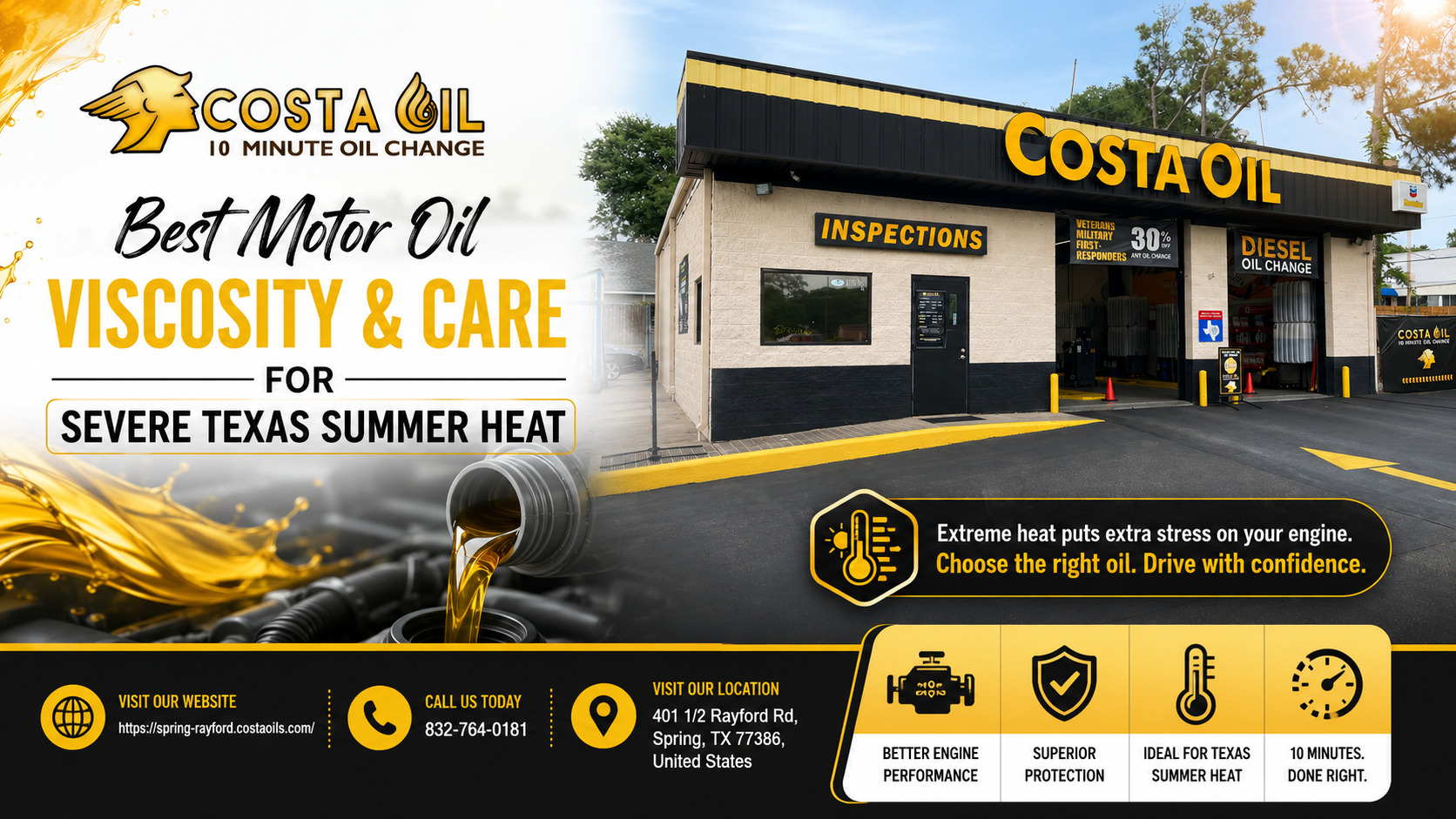
Best Motor Oil Viscosity & Care for Severe Texas Summer Heat
Extreme Texas heat puts incredible strain on your vehicle's engine, making proper lubrication and viscosity management essential for preventing costly breakdowns. In this comprehensive guide, we explain everything you need to know about choosing the right motor oil viscosity to protect your car and keep it running smoothly all summer long.
Navigating Summer Driving in Spring, Texas: The Ultimate Engine Protection Guide
If you've lived through a Texas summer, you already know the pavement isn't the only thing suffering under triple-digit temperatures. Your engine is fighting its own battle against heat, and the oil circulating through it is your first line of defense. In our earlier post on how Texas heat affects engine oil, we broke down why extreme heat accelerates oil breakdown. This guide picks up where that one left off — walking you through exactly which viscosity grade protects your engine best, why manufacturer specs matter more than ever in summer, and how synthetic oil holds up when conventional oil starts to fail.
Whether you're commuting on I-45, idling in Woodlands-area traffic, or towing a trailer down FM 2978, the right viscosity choice can be the difference between routine maintenance and an expensive repair bill.
Deconstructing Motor Oil Viscosity: What the Numbers Mean for Texas Drivers
The Fundamentals of Fluid Viscosity
Viscosity is simply a measurement of a fluid's resistance to flow. Thicker fluids (like honey) have high viscosity; thinner fluids (like water) have low viscosity. Motor oil needs to strike a careful balance — thin enough to circulate quickly and protect critical engine components during a cold start, but thick enough to maintain a protective film between moving metal parts once the engine reaches full operating temperature.
The challenge is that oil's viscosity isn't fixed. It changes with temperature, which is precisely why the automotive industry developed a standardized rating system in the first place.
Deciphering the SAE Viscosity Rating (0W-20, 5W-30, and Beyond)
The Society of Automotive Engineers (SAE) rating you see on every bottle of oil — 0W-20, 5W-30, 5W-40, and so on — tells you how that oil behaves across a temperature range:
The number before the "W" (Winter) indicates how the oil flows in cold conditions. A lower number means the oil stays thinner and flows more easily during cold starts.
The number after the "W" indicates the oil's viscosity at normal operating temperature (around 212°F). A higher number means the oil stays thicker and maintains better protection under heat and stress.
For most modern vehicles, manufacturers specify a range like 0W-20 or 5W-30 as a factory-tested balance of fuel efficiency and protection. But that number was calculated with an assumption about the operating environment — and Texas summers push well past what many of these calculations were modeled on.
The Impact of Texas Heat on Oil Viscosity
Here's where things get serious for Texas drivers. When ambient temperatures regularly climb above 100°F, and under-hood temperatures can exceed 250°F, oil is put under thermal stress far beyond what drivers in milder climates experience.
Under sustained extreme heat, motor oil can:
Thin out prematurely, reducing the protective film between moving parts and increasing metal-on-metal contact.
Oxidize faster, forming sludge and varnish deposits that clog oil passages and reduce lubrication efficiency.
Lose viscosity index stability, meaning the oil no longer performs consistently across the temperature swings common in a Texas driving day — a cool early morning commute followed by an afternoon spent baking in a parking lot.
This is why viscosity selection isn't just a manufacturer's suggestion to follow blindly — it's a decision that needs to account for your specific climate and driving conditions.
Modern Engine Tolerances vs. High-Temperature Demands
The Evolution of Modern Engine Design
Newer engines are built with significantly tighter tolerances than their predecessors — the microscopic gaps between moving parts like pistons, bearings, and camshafts have shrunk considerably in the pursuit of fuel efficiency and reduced emissions. This is part of why so many manufacturers now spec thinner oils like 0W-20 as standard.
Thinner oils reduce friction and improve fuel economy under normal conditions. But tighter tolerances also mean there's less margin for error. When oil thins further under extreme heat, it has far less room to maintain the protective barrier these tightly engineered components depend on. In other words, the same engineering that improves your gas mileage in spring or fall can leave your engine more vulnerable during a Texas summer if the oil isn't performing exactly as designed.
Why Sticking to Manufacturer Viscosity Specifications Matters
It might be tempting to assume that "thicker is always better" for hot climates, but deviating from your manufacturer's specified viscosity — in either direction — can cause real problems.
Going thicker than recommended can restrict oil flow to critical components, especially during cold starts, and may reduce fuel efficiency. Going thinner invites the heat-related breakdown issues outlined above. Manufacturers test their specified viscosity extensively against the engine's actual tolerances, so straying from that number — even with good intentions — can undermine performance rather than improve it.
The better approach: stick to the manufacturer's specification, but be far more diligent about oil quality, change intervals, and oil grade (synthetic vs. conventional) during the hottest months of the year.
Synthetic vs. Conventional Oil: Battling Extreme Thermal Stress
This is where the real differentiator emerges for Texas drivers. Conventional oil is refined from crude petroleum and contains a wider range of molecule sizes, which makes it more prone to breaking down and oxidizing under extreme heat. Synthetic oil, by contrast, is chemically engineered with uniform molecular structures, giving it significantly more resistance to thermal breakdown.
In practical terms, this means synthetic oil maintains its intended viscosity for longer under the kind of sustained high temperatures that define a Texas summer — protecting your engine even during long highway drives, stop-and-go traffic, or towing under a blazing sun.
Key Advantages of Full Synthetic Oil in Summer Conditions
Superior thermal stability: Full synthetic oil resists breakdown and viscosity loss even at extreme under-hood temperatures.
Reduced sludge and deposit formation: Synthetic oil's refined molecular structure produces fewer of the oxidation byproducts that clog oil passages.
Extended protection between changes: Synthetic oil typically maintains its protective properties longer, which matters when summer heat is accelerating wear year-round.
Better performance across temperature swings: From a cool morning start to a scorching afternoon, synthetic oil maintains a more consistent viscosity index.
For drivers logging significant miles during a Texas summer, full synthetic oil isn't a luxury upgrade — it's a practical safeguard for engine longevity.
3 Critical Summer Oil Maintenance Strategies for Spring, TX Drivers
1. Shorten Your Oil Change Intervals During Peak Heat. Extreme heat accelerates oil breakdown, meaning the manufacturer's "normal condition" change interval may not fully apply during a Texas summer. Many manufacturers actually classify sustained high heat as a "severe driving condition," which warrants more frequent oil changes.
2. Verify Your Oil Grade Matches Manufacturer Specs — Every Time. It's easy to assume "any oil will do" during a routine top-off or change, but confirming the exact viscosity grade specified for your make and model should be a non-negotiable step at every service visit.
3. Monitor Fluid Levels More Closely in Summer Heat: Summer heat increases oil consumption and evaporation rates. Checking your oil level more frequently during the summer months — not just at scheduled service intervals — helps catch potential issues before they become expensive engine damage.
Professional Local Expertise Without the Wait
Staying on top of these strategies is a lot easier when you have a trusted local team handling the details. At Costa Oil Spring Rayford, our technicians are trained specifically for the demands Texas heat places on local vehicles—not generic, one-size-fits-all maintenance schedules. If you need a fast 10-minute oil change that fits into your day without sacrificing quality, our drive-through service is built exactly for that.
Protect Your Engine This Summer at Costa Oil Spring Rayford
Navigating proper viscosity selection and maintenance schedules doesn't have to be complicated. At Costa Oil Spring Rayford, our team provides fast, professional drive-through oil change services targeted to local Texas driving conditions.
The Costa Oil Advantage
Fast 10-Minute Drive-Through Service: Complete your vehicle maintenance without leaving your car.
No Appointments Required: Drive in whenever it fits your daily routine.
Zero High-Pressure Upselling: Receive transparent recommendations focused strictly on your vehicle manufacturer's guidelines.
18-Point Maintenance Inspection: Every service includes vital fluid checks to keep your vehicle operating smoothly throughout the summer heat.
Visit our location on Rayford Road today or check our latest 10-minute oil change coupons before your next visit to keep your engine protected all summer long!
Conclusion
Protecting your engine against the severe Texas summer heat comes down to understanding motor oil viscosity in high heat and adhering strictly to your vehicle manufacturer’s specifications. High ambient temperatures accelerate oil breakdown, but using full synthetic lubricants provides the thermal stability and resistance to breakdown needed to keep vital components safe. By pairing the right high-performance synthetic oil with routine fluid monitoring and timely service, drivers in Spring, Texas can prevent severe mechanical wear and avoid costly repairs. For fast, dependable vehicle care designed specifically for local driving conditions, stop by Costa Oil Spring Rayford. Our drive-through service requires no appointment and includes a full 18-point maintenance inspection to ensure your car stays road-ready all summer long.
Frequently Asked Questions (FAQs)
Q: Why does Texas summer heat affect my vehicle's motor oil?
A: High temperatures cause standard motor oil to thin out faster and oxidize, reducing its ability to coat internal engine components and protect against friction during operation.
Q: Should I switch to a thicker oil viscosity during the summer?
A: It is generally best to stick strictly to the manufacturer-recommended viscosity rating, as modern engines are built with tight tolerances that require specific oil weights to function correctly regardless of the season.
Q: Why is full synthetic oil recommended over conventional oil for summer driving?
A: Full synthetic oil offers superior thermal stability, better oxidation resistance, and consistent viscosity breakdown resistance compared to conventional oil, making it far more effective in extreme summer heat.
Q: Do I need an appointment for service at Costa Oil Spring Rayford?
A: No, Costa Oil Spring Rayford provides quick, 10-minute drive-through oil changes with no appointment required.