
401-1/2 Rayford Rd, Spring, TX 77386
Mon-Fri: 7:30 AM–6 PM - Sat: 7:30 AM–5 PM - Sunday Closed
10-Minute, Drive Through Oil Changes in Spring
Affordable Oil Changes For
Those Who Value Their Time
No Appointment Necessary
No High Pressure Upsells
No Need to Leave Your Vehicle
Oil Change Service Charlotte & Rock Hill
Proud Partners With





Ethical
Our company motto is “The Most Educated Customer Will Choose Us.” We want to help you explore your vehicle and its options, and learn about the services we provide.

Affordable
Our simplified business model allows us to price our services below the competition, helping to better serve you, the end consumer. Stop by today and experience the Costa difference.

100% Oil Change Only
We stay true to the original quick lube model. Fast oil changes with no high-pressure up-selling. It’s a no-brainer. Stop by and see us today for fast oil changes.
Current Oil Change Coupons
We know you work hard for your money. Costa oil offers you these coupons to save on your next Oil Change. We also have deals for batteries, filters and windshield wipers. For more deals, please check our facebook page https://www.facebook.com/costaoilspringtx
These offers are only valid at the Rayford Rd Location. Cannot be combined with other offers.
30% Off
Coupon
Veterans,
Military & First Responders
get
30% off
Any Oil Change
Must show proof of service or
military ID.
Expires 12/31/2026
$10 Off
Coupon
$10 off
Any
Full Synthetic
Oil Change
Cannot be combined with any other offers
expires 07/31/2026
$10 Off
Coupon
$10 off
Any
Diesel
Oil Change
Cannot be combined with any other offers
Expires 07/31/2026
LOOKING FOR OIL CHANGE PRICING?

Why Choose Costa Oil Spring Rayford Rd
We provide fast, friendly, affordable oil changes at our locally owned and operated facility.
No appointment needed. Drive-through service. Best service in town!

No High Pressure Upselling
We specialize in oil changes. With no other expensive automotive services to upsell, you can be sure you’re receiving honest, quality service—and only what your vehicle currently needs.

Quality Service & Products
Our oil change technicians are trained to work on all makes and models. We stand behind our professional service and high quality products.

18-Point Oil Experience
Our oil change service includes a comprehensive check of fluids, tire pressure, wipers, and more.

Low Prices & Big Savings
Our oil change prices are incredibly competitive. Call us for a quote today!
Frequently Asked Questions
How long does an oil change take at Costa Oil Spring, TX?
Most services at Costa Oil – 10 Minute Oil Change Spring Rayford are completed in about 10 minutes without needing an appointment.
Do I need an appointment for an oil change in Spring, TX?
No appointment is needed at Costa Oil Spring Rayford. Drivers can simply pull in for a quick 10-minute oil change service.
Can I stay in my car during an oil change?
Yes, customers at Costa Oil – 10 Minute Oil Change Spring Rayford can stay comfortably inside their vehicles throughout the entire oil change service.
What types of oil change services do you offer in Spring, TX?
Costa Oil Spring Rayford offers synthetic blend, and full synthetic oil changes for most cars, trucks, and SUVs.
What makes Costa Oil different from other oil change shops in Spring TX?
Costa Oil stands out in Spring, TX, for fast drive-through service, affordable pricing, no-pressure recommendations, quality oils, and the convenience of staying in your vehicle.
Resource Center
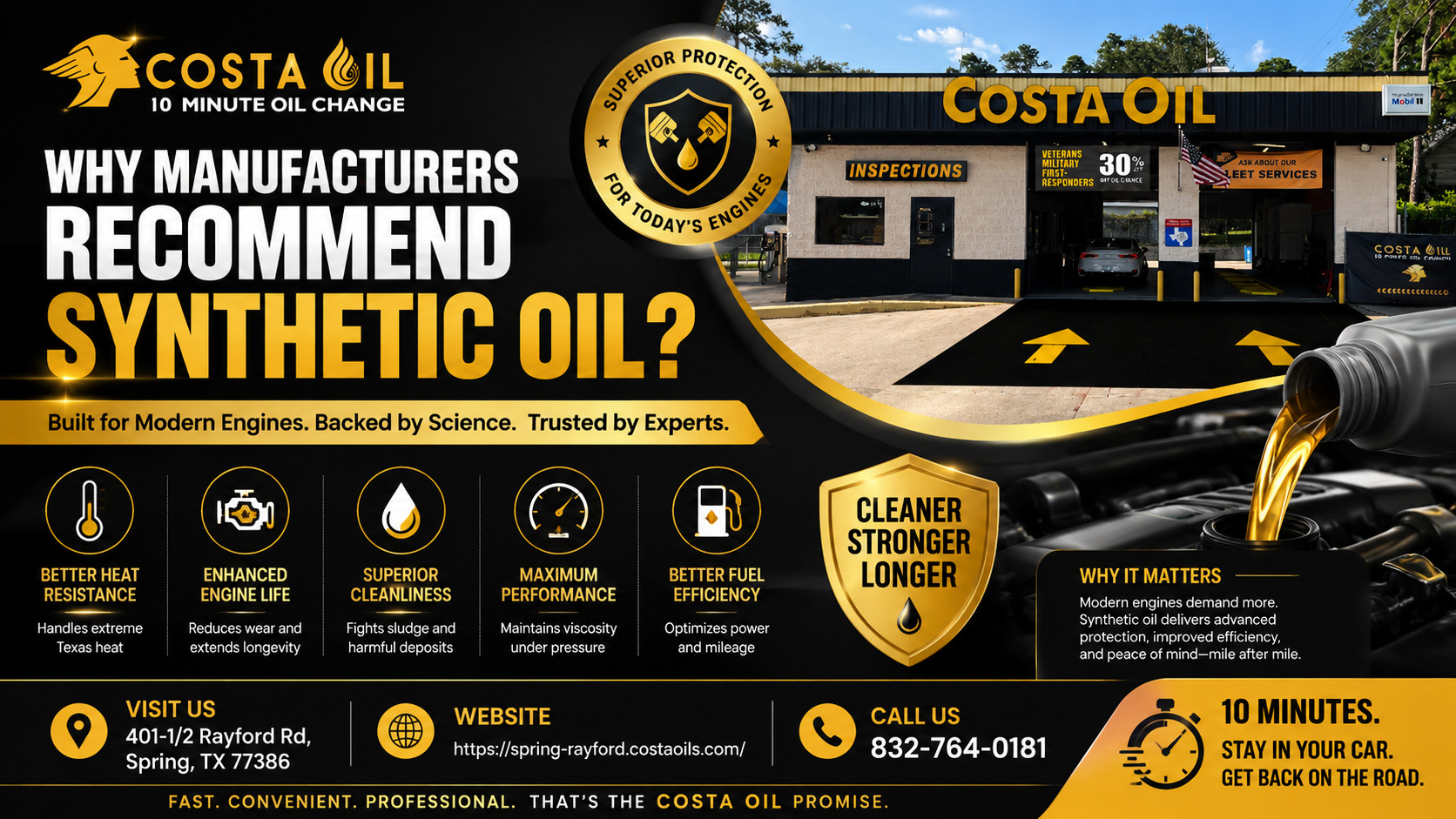
Why Manufacturers Recommend Synthetic Oil?
Modern vehicles are more efficient, more powerful, and more technically advanced than cars built a few decades ago. Engines now use tighter internal tolerances, turbochargers, variable valve timing, direct fuel injection, advanced emissions systems, and sophisticated oil-life monitoring technology. These developments help manufacturers produce more power from smaller engines while improving fuel economy and lowering emissions. However, they also place greater demands on engine oil.
That is one of the main reasons many automakers now recommend or require synthetic or synthetic-blend motor oil. Synthetic oil is engineered to maintain more consistent protection under high temperatures, cold starts, heavy traffic, towing, and other demanding operating conditions. For drivers in Spring, TX, these benefits are particularly relevant. Summer heat, frequent idling, stop-and-go traffic, short local journeys, and highway commuting can all increase the stress placed on an engine.
When you search for a synthetic oil change near you, the objective should not simply be to choose the most expensive oil available. The correct choice is the oil that meets the viscosity grade, performance category, and manufacturer specification listed in your vehicle’s owner’s manual.
At Costa Oil – 10 Minute Oil Change Spring Rayford, drivers can receive a fast, drive-through synthetic oil change without an appointment and without leaving their vehicle.
1. The Evolution of Engine Protection
1.1 How Vehicle Engineering Has Changed
Older engines were generally larger, less efficient, and built with wider internal tolerances. Many could operate effectively with conventional motor oil because their designs placed fewer extreme demands on the lubricant.
Modern engines are different.
Manufacturers increasingly use smaller engines with turbochargers to generate power that previously required a much larger engine. Fuel injection systems are more precise, emissions limits are stricter, and many engine components rely on oil pressure for accurate operation.
Modern oil may be responsible for:
Lubricating bearings, pistons, camshafts, and valve components
Cooling areas that engine coolant does not directly reach
Supporting turbocharger bearings
Operating variable valve timing systems
Keeping timing-chain components lubricated
Limiting deposits inside narrow oil passages
Protecting emissions-related engine systems
These functions require oil that can circulate rapidly, resist extreme heat, and maintain the correct viscosity throughout the service interval.
Automakers therefore specify more than a general oil type. They may require a precise SAE viscosity, an API performance category, an ILSAC standard, or a manufacturer-specific approval such as GM Dexos or a Ford engineering specification. API advises drivers to follow their engine manufacturer’s recommendations when selecting an oil category and viscosity.
1.2 Conventional vs. Synthetic Oil: A Quick Overview
Conventional oil is refined from crude oil and combined with additives that improve cleaning, corrosion protection, oxidation resistance, and viscosity performance. Synthetic oil is also derived from carefully processed base materials, but its molecular structure and additive system are engineered for more consistent performance.
A synthetic blend combines conventional and synthetic base oils. It can provide stronger protection than basic conventional oil at a lower price than full synthetic oil. The main difference is not that conventional oil provides no protection. Many engines can still use it safely when the manufacturer permits it. The advantage of synthetic oil is that it generally performs more consistently under severe temperature, load, and operating conditions.
AAA laboratory testing found that synthetic oils performed an average of 47 percent better than conventional oils across the industry-standard tests included in its study. AAA also identified turbocharged engines, stop-and-go traffic, towing, and extreme temperatures as situations in which synthetic oil may offer particular value.
2. Unmatched Protection Against Extreme Temperatures
2.1 Superior Resistance to High Texas Summer Heat
Spring, TX drivers are familiar with long periods of high temperatures. Although engine oil operates at temperatures far above the surrounding air, hot weather adds to the total thermal demand placed on the vehicle. Heat can accelerate oxidation, a chemical process that gradually degrades engine oil. As oxidation progresses, oil may thicken, lose protective properties, and contribute to varnish or sludge deposits.
Full synthetic oil generally has stronger oxidation resistance than conventional oil. This helps it maintain its protective qualities during:
Summer traffic
Extended idling
Long highway drives
Towing
Heavy loads
Turbocharged operation
Frequent acceleration and braking
This does not mean synthetic oil lasts indefinitely or that Texas drivers can ignore the manufacturer’s maintenance schedule. It means the oil has been formulated to resist breakdown more effectively while it remains within its approved service interval. Drivers searching for a full synthetic oil change near me should also verify that the oil meets the exact specification required by their vehicle. The words “full synthetic” alone do not confirm compatibility.
2.2 Faster Oil Flow and Friction Reduction During Cold Starts
Texas is associated with heat, but Spring can still experience cool winter mornings and significant seasonal temperature changes. When an engine is first started, much of its oil has settled in the oil pan. The oil pump must circulate lubricant quickly to the upper parts of the engine. Synthetic oils generally flow more readily at low temperatures than conventional oils of comparable intended use. Faster circulation can help reduce the amount of time engine components operate before receiving full lubrication.
The first number in a multigrade oil designation, such as 0W-20 or 5W-30, describes low-temperature performance. The second number describes viscosity characteristics at normal operating temperature. A lower first number does not automatically make an oil suitable for every vehicle. The correct grade must still match the owner’s manual.
Some manufacturers specify alternative viscosity grades only for extremely cold climates. Ford owner-manual specifications, for example, show that the required viscosity and engineering standard can vary by engine and operating temperature.
3. Advanced Engine Longevity and Performance
3.1 Preventing Sludge and Chemical Breakdown
Sludge is a thick deposit formed when degraded oil combines with contaminants, moisture, combustion by-products, and oxidation products. Sludge can obstruct oil passages, restrict circulation, interfere with variable valve timing, and reduce the engine’s ability to protect moving parts.
Synthetic oils generally contain highly refined base oils and strong detergent and dispersant packages. These characteristics can help resist deposit formation and keep contaminants suspended until they are captured by the oil filter or removed during the next oil change.
However, even premium synthetic oil can form deposits when:
Oil changes are repeatedly delayed
The wrong oil specification is used
The engine overheats
Coolant contaminates the oil
Fuel dilution becomes excessive
The vehicle makes frequent short trips
The oil level is consistently low
Using synthetic oil is therefore one part of proper engine maintenance, not a substitute for it.
3.2 Maintaining Optimal Engine Oil Viscosity
Viscosity describes the oil’s resistance to flow. Engine oil must be thin enough to circulate quickly but thick enough to maintain a protective film between moving components. If oil becomes too thick, it may circulate slowly and increase internal drag. If it becomes too thin, it may not maintain sufficient protection under heat and load.
Synthetic oil generally maintains its viscosity more consistently across a broad temperature range. This is important in modern engines with narrow oil passages, hydraulic valve systems, timing-chain tensioners, and turbocharger bearings. Manufacturers test engines using specific viscosity grades and performance standards. Using a thicker oil simply because the weather is hot may interfere with oil flow, fuel economy, emissions performance, or hydraulically controlled engine systems.
The best approach is to use the specified viscosity rather than selecting oil based on assumptions about Texas weather.
3.3 Enhanced Protection for Turbocharged and Modern Engines
Turbochargers use exhaust energy to force additional air into the engine. This allows a smaller engine to produce more power, but the turbocharger itself can spin at extremely high speeds and operate in a very hot environment. Engine oil lubricates and cools the turbocharger bearings. When unsuitable oil breaks down or leaves deposits, the narrow passages supplying the turbo may become restricted.
Synthetic oil is often recommended for turbocharged engines because it typically resists high-temperature deposits and maintains more stable lubrication. Direct-injection and turbocharged gasoline engines can also face low-speed pre-ignition, timing-chain wear, and deposit concerns. Newer API and ILSAC standards include tests designed to address these modern engine requirements. API’s current gasoline-oil classifications include API SP and ILSAC GF-6 standards intended for modern engine protection.
Drivers should not assume that every synthetic oil meets every modern standard. Check for the required certification mark and manufacturer approval.
4. Financial and Practical Benefits for Drivers
4.1 Extended Intervals Between Oil Changes
Synthetic oil may support longer service intervals because it generally resists oxidation and viscosity breakdown better than conventional oil. Many modern manufacturer schedules commonly fall around 5,000, 7,500, or 10,000 miles. Some vehicles permit longer distances, while others require shorter intervals because of engine design or severe operating conditions.
The important point is that synthetic oil does not automatically allow every driver to travel 10,000 or 15,000 miles between services.
Follow whichever limit applies first:
The vehicle’s oil-life monitor
The manufacturer’s mileage interval
The manufacturer’s time interval
The severe-service schedule
The approved oil’s limitations
A vehicle driven only a few thousand miles per year may still require an oil change based on time. Similarly, a vehicle used for towing, delivery work, frequent short trips, or extensive idling may require earlier service.
4.2 Improved Fuel Efficiency and Mileage
Synthetic oil can reduce internal friction because it maintains more consistent flow and viscosity. This may support the fuel-economy performance the engine was designed to achieve. However, drivers should be cautious about exaggerated claims. Switching to synthetic oil will not produce a dramatic fuel-economy increase in every vehicle.
Actual mileage depends on:
Engine design
Vehicle weight
Tire pressure
Driving speed
Traffic
Air-conditioning use
Maintenance condition
Fuel quality
Driving habits
Using the correct low-viscosity synthetic oil can help the engine operate efficiently, but it should be viewed as one part of vehicle maintenance rather than a guaranteed fuel-saving solution.
4.3 Long-Term Savings on Major Engine Repairs
Full synthetic oil usually costs more upfront than conventional oil. However, stronger resistance to oxidation, sludge, and high-temperature breakdown may help reduce long-term engine wear when synthetic oil is appropriate for the vehicle.
Potential financial benefits can include:
Longer approved service intervals
Better protection during severe driving
Reduced deposit formation
Greater turbocharger protection
Fewer lubrication-related problems
Improved engine cleanliness
No oil can prevent every engine failure. Cooling-system problems, manufacturing defects, fuel-system issues, neglected repairs, and mechanical wear can still cause expensive damage. Synthetic oil should therefore be seen as preventive protection rather than a guarantee against future repairs.
5. Why Vehicle Manufacturers Explicitly Require Synthetic Oil
5.1 Meeting Strict OEM Standards
An OEM is the original equipment manufacturer that designed and built the vehicle. OEMs test engines using particular oil grades and performance specifications. These requirements may cover:
High-temperature deposit control
Timing-chain wear
Turbocharger protection
Low-speed pre-ignition resistance
Fuel economy
Emissions-system compatibility
Sludge resistance
Cold-start performance
Some manufacturers require a synthetic blend. Others require full synthetic oil or an oil carrying a particular proprietary approval.
For example, Ford owner-manual specifications may identify both the SAE grade and a Ford engineering standard. General Motors uses its dexos licensing system to identify oils that meet GM performance requirements.
Using the wrong viscosity or an oil that lacks the required approval can affect engine operation even when the bottle says “synthetic.”
5.2 Maintaining Engine Warranty Coverage
Drivers frequently hear that they must visit a dealership for every oil change to keep the warranty valid. That is not generally accurate. The FTC explains that an auto warranty or service contract may require the owner to follow the manufacturer’s routine maintenance recommendations. Drivers should keep receipts and service records showing that required maintenance was completed.
Federal warranty rules also generally prevent a manufacturer from requiring a particular branded product unless it is provided free or another lawful exception applies. This means the important issue is usually whether the oil met the required specification—not whether it carried the dealership’s brand name.
To support warranty records:
Follow the manufacturer’s oil change schedule.
Use the correct viscosity and specification.
Replace the appropriate oil filter.
Keep dated receipts and service documentation.
Check oil levels between services.
Respond promptly to oil-pressure or maintenance warnings.
Failing to follow the required schedule or using an unsuitable oil may affect coverage for damage connected to that neglect. It does not necessarily cancel every part of the vehicle warranty automatically.
6. Fast and Convenient Synthetic Oil Changes at Costa Oil
6.1 Fast 10-Minute Drive-Through Service
When drivers search for a synthetic oil change near me or quick oil change near me, they often want a service that fits into a busy day. Costa Oil – 10 Minute Oil Change Spring Rayford operates with a drive-through model focused on speed and convenience.
Customers can drive directly into the service bay and remain inside their car, truck, or SUV while the oil and filter are changed. Most services are completed in about 10 minutes, although timing can vary based on the vehicle, oil capacity, filter access, and bay traffic.
6.2 No Appointment and No High-Pressure Upsells
Costa Oil Spring Rayford does not require an appointment. Drivers can visit during operating hours and receive service according to current bay availability. The location focuses on oil change services rather than using the visit to sell extensive mechanical repairs. Technicians can help drivers identify the correct oil option while keeping the process straightforward.
The service is particularly convenient for:
Parents travelling with children
Drivers with pets
Seniors
Commuters
Rideshare drivers
Pickup and SUV owners
Drivers who prefer not to use a waiting room
Customers remain in control and can see the service being performed from the driver’s seat.
6.3 Synthetic Oil Coupons and Savings
Costa Oil Spring Rayford regularly provides local oil change specials. A recent offer promoted $20 off a full synthetic oil change, making premium engine protection more affordable for eligible customers. Coupon availability, expiry dates, and terms can change, so drivers should review the current Specials page or call the location before visiting.
The location has also promoted a 30 percent oil change discount for veterans, active military members, and first responders, subject to identification and current offer terms.
Visit Costa Oil Spring Rayford
Choosing synthetic oil is not simply about paying for a premium product. It is about matching the oil to the way modern engines are designed. For many newer, turbocharged, high-performance, or heavily used vehicles, synthetic oil provides the temperature stability, deposit resistance, and viscosity performance required by the manufacturer.
Costa Oil Spring Rayford can help local drivers identify an appropriate oil change option based on the vehicle’s year, make, model, engine, viscosity requirement, and OEM specification.
Frequently Asked Questions
Why do newer vehicles require synthetic oil?
Newer engines often use turbochargers, tighter tolerances, narrow oil passages, and advanced valve systems. Synthetic oil provides greater resistance to heat, oxidation, deposits, and viscosity breakdown.
Is synthetic oil better for Texas heat?
Synthetic oil generally resists oxidation and high-temperature breakdown better than conventional oil, making it useful for hot weather, traffic, towing, and other demanding conditions.
How often should synthetic oil be changed?
Follow the manufacturer’s mileage and time interval or the vehicle’s oil-life monitor. Common intervals include 5,000, 7,500, and 10,000 miles, but the correct schedule varies.
Can synthetic oil improve fuel economy?
The correct synthetic oil may reduce internal friction and support efficient operation, but any fuel-economy improvement is usually modest and depends on the vehicle and driving conditions.
Does synthetic oil prevent sludge?
Synthetic oil generally resists oxidation and deposit formation better than conventional oil. Sludge can still develop when changes are delayed or the engine has mechanical or contamination problems.
Is synthetic oil necessary for turbocharged engines?
Many turbocharged engines require or strongly recommend synthetic oil because the turbocharger operates under high heat and speed. Always check the owner’s manual.
Will using a non-dealer oil change void my warranty?
Using an independent oil change provider does not automatically void a warranty. The service should follow the manufacturer’s schedule and use oil meeting the required viscosity and performance specification.
Can I switch from conventional to synthetic oil?
Many vehicles can switch safely when the synthetic oil meets the required specifications. Do not switch away from synthetic oil when the manufacturer requires it.
Do I need an appointment at Costa Oil Spring Rayford?
No. Drivers can pull into Costa Oil Spring Rayford during operating hours without scheduling an appointment.
Can I stay in my car during a synthetic oil change?
Yes. Costa Oil Spring Rayford provides a drive-through service where customers remain comfortably inside their vehicles throughout the oil change.