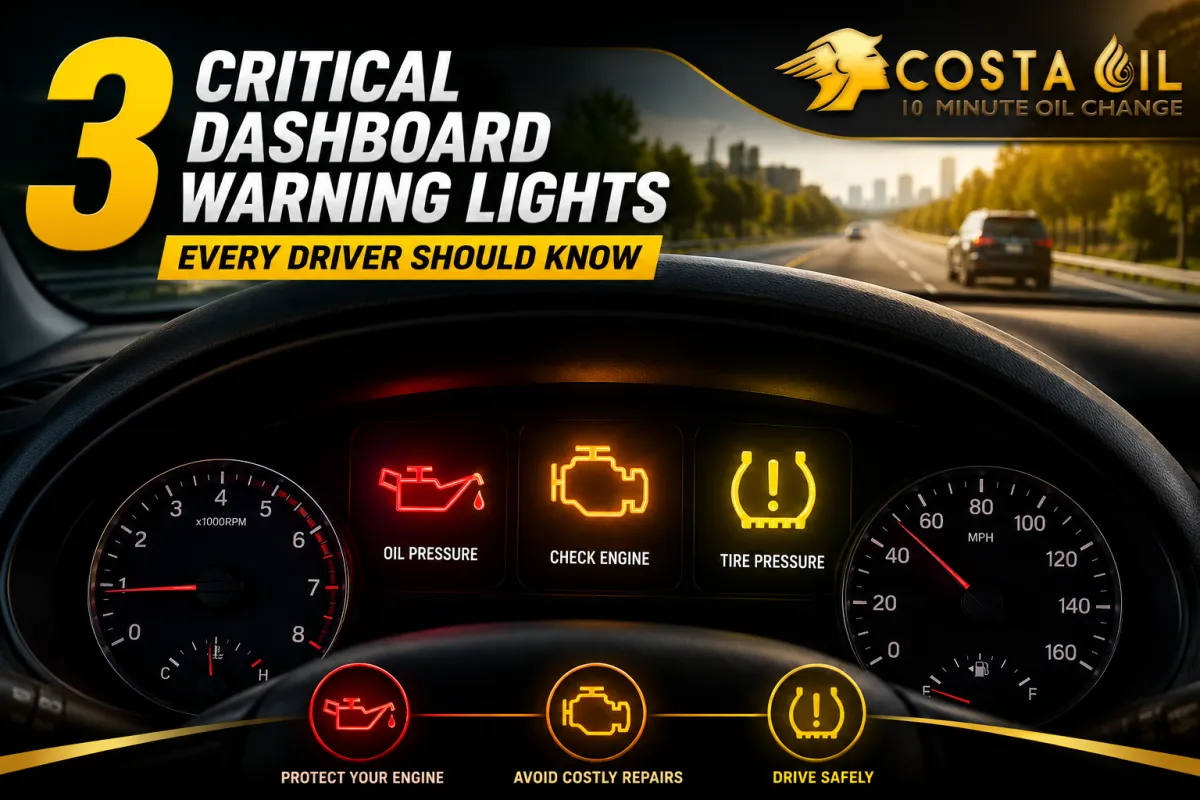
3 Critical Dashboard Warning Lights Every Spring, TX Driver Should Know
What are the most dangerous dashboard warning lights that can ruin your car and empty your wallet?
The three critical warning lights you must never ignore are the oil pressure warning light, the check engine light, and the tire pressure monitoring system (TPMS) light. Ignoring these glowing symbols can transform a minor, inexpensive fix into a catastrophic mechanical failure within minutes.
One ignored warning light can quietly turn a $50 fix into a $7,000 engine replacement. Yet, a massive consumer survey published by Kelley Blue Book revealed that 25% of drivers completely ignore their check engine light indefinitely.
Another 29.6% wait anywhere from a week to a full year before having it diagnosed. If you are driving in intense Texas heat with that light glowing on your dashboard, the clock moves much faster. This guide closes that gap by breaking down exactly what those lights mean and what happens when you look the other way.
Decoding Your Dashboard: Why You Shouldn't Ignore the Signs
Think of dashboard warning lights like a smoke detector; you wouldn't pull the batteries to stop the annoying beep. They provide critical alerts before damage escalates. While some signify urgent emergencies, others are early warnings. Understanding these differences stops you from panicking over minor issues or dismissing these three most costly repairs.
Cost of Delay: How Preventive Maintenance Saves Your Engine (and Wallet)
A full engine replacement costs $4,000–$7,000 according to J.D. Power; over $10,000 for luxury vehicles. A routine oil change costs a fraction of that. The gap between those two numbers is almost always just time spent driving with a light on, hoping it sorts itself out.
Research from the Automotive Aftermarket E-Learning Center shows the #1 reason drivers skip maintenance isn't money; it's time (33%). Another 30.3% think it costs too much, not realizing that ignoring it costs far more. Small maintenance now, or large repair later.
Statistics: Why 1 in 5 Texas Drivers Are Putting Their Vehicles at Risk
The same KBB survey found men are nearly twice as likely as women to dismiss dashboard lights (32% vs. 18.4%). Drivers under 35 are the most likely to delay, usually figuring they'll deal with it "when it gets worse."
In a Texas summer, "worse" arrives faster than anywhere else. Heat breaks down oil faster. Stop-and-go traffic stresses every system. Temperatures swinging 40°F between morning and afternoon throws tire pressure off daily. All three lights in this guide are directly affected, which means the risk here is higher than national averages suggest.
Here are the three lights that matter most, and exactly what to do when each comes on.
Light #1: Red Oil Can; Oil Pressure Warning
What it means: Your engine doesn't have enough oil pressure to stay protected. Metal parts are grinding against each other right now.
What you should do: Pull over. Turn off the engine. Don't drive it "just a little further."
Even a few minutes of driving with no oil pressure can destroy your engine. A routine oil change costs a tiny fraction of that.
Why does it happen? Usually one of these:
Oil level is too low (slow leak or burning oil)
The oil filter is clogged
Oil has turned to sludge from going too long without a change
The oil pump is starting to fail
A Texas-specific note: Spring summers regularly hit 95–100°F. That heat breaks down oil faster than the standard change interval assumes. Add in stop-and-go traffic on roads like Rayford, and your oil wears out quicker than you might expect. If you're doing a lot of short trips and highway commutes, change your oil on the shorter end of your manufacturer's recommendation.
Light #2: Amber Engine Outline; Check Engine Light
What it means: Your car's onboard system detected something off. Could be minor. Could be serious. You won't know until it's scanned.
Here's the one thing most people get wrong: solid vs. flashing makes a big difference.
Solid light → Get it checked soon, but it's not an emergency. Drive carefully.
Flashing light → Stop driving. An active engine misfire can destroy your catalytic converter fast, a repair that typically runs $1,000-$2,500+.
Common triggers, from easy to expensive:
Loose or cracked gas cap (most common, easiest fix)
Dirty mass airflow sensor
Failing oxygen sensor
Clogged engine air filter (more on this below)
Misfiring cylinder
Failing catalytic converter
Don't overlook the air filter. A clogged engine air filter starves the engine of clean airflow. The engine management system picks this up and can trigger the check engine light. Texas pollen season runs from February through the fall, and construction dust around growing suburbs doesn't help. Filters clog faster here. Checking it takes seconds during an oil change.
Light #3: Horseshoe with an Exclamation Point; Tire Pressure Warning
What it means: At least one tire has dropped 25% or more below its recommended PSI. That's the federal threshold that triggers the TPMS (Tire Pressure Monitoring System), which has been required on all US vehicles since 2008.
Why Texas makes this tricky: Tire pressure changes with temperature, roughly 1 PSI per 10°F. This is a daily reality here from spring through fall.
What's at stake:
Underinflated tires wear unevenly and wear out faster.
Handling worsens, especially during sudden stops or sharp turns.
Fuel economy drops; the US Department of Energy confirms that proper inflation and oil grade together can improve gas mileage by 1-2%
Blowout risk goes up significantly at highway speeds.
Oil Types: Conventional, Synthetic Blend, or Full Synthetic; What's Right for Your Car?
Quick breakdown:
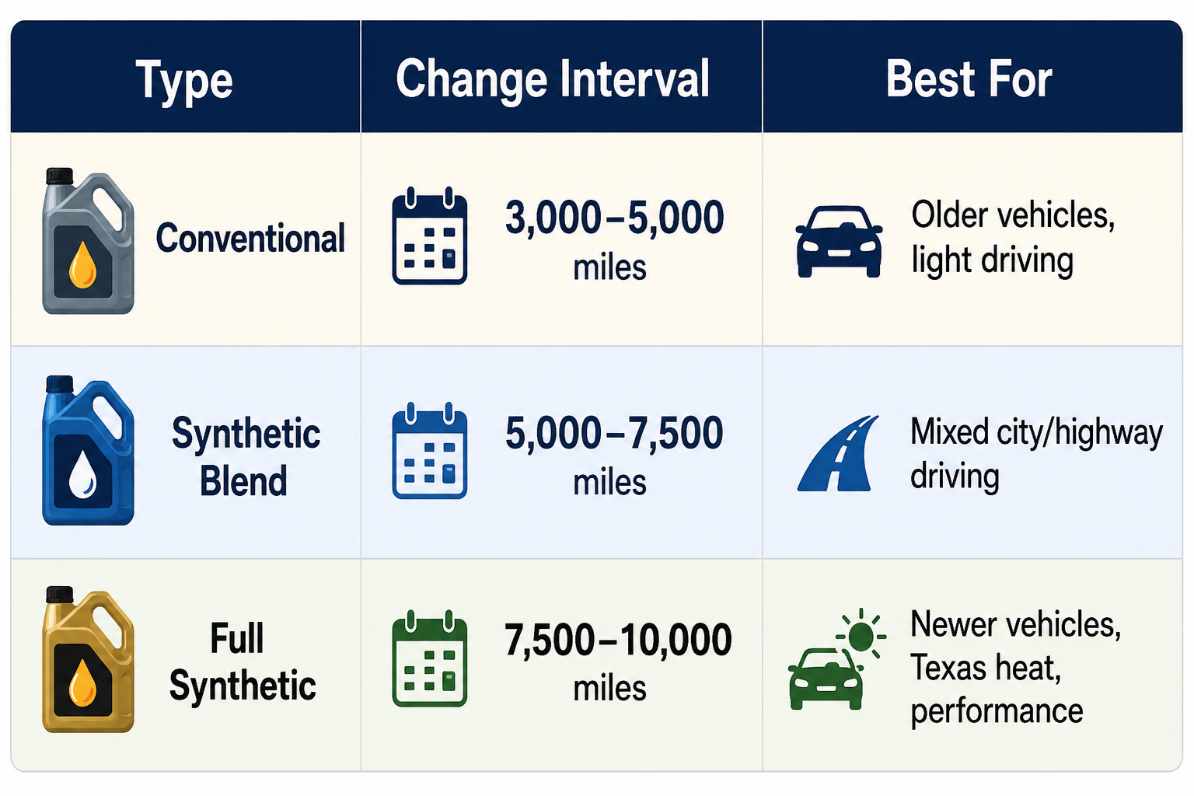
About 70% of newer vehicles now require full synthetic. It costs more upfront, but lasts longer, making it cheaper per mile. If you're not sure which your car needs, the technicians at Costa Oil will check your manufacturer's spec before touching anything.
FAQs
1. Can I drive a short distance with the red oil pressure light on?
Absolutely not. Driving even a quarter-mile with zero oil pressure can cause irreversible structural damage to your engine. Pull over immediately and turn off the ignition. To prevent this crisis, pull in for a Speedy Oil Change to restore vital lubrication.
2. How many miles can I safely go over my oil change interval?
It is highly recommended not to exceed your interval at all. Postponing services allows chemical additives to break down, leaving your engine vulnerable to friction. Routinely practicing Preventive Maintenance Services keeps your engine running within safe, manufacturer-approved limits.
3. Does engine oil go bad or clump if I don't drive my car frequently?
Yes, oil degrades over time and collects moisture from condensation even if your car sits idle. If you do not hit your mileage targets, you should still get a Drive-Thru Oil Change at least twice a year to remove contaminated fluid.
4. What happens if I ignore a flashing Check Engine light?
A flashing amber light indicates a severe engine misfire that can rapidly melt your catalytic converter. You should immediately get a Vehicle engine diagnostic to read the trouble code and fix the underlying issue before it triggers an expensive breakdown.
5. Do I need to make an appointment at Costa Oil Spring Rayford?
No, appointments are never necessary for any of our vehicle care options. You can drive up whenever it fits your schedule and get a Minute Oil Change or fluid checkup immediately without ever leaving your vehicle.
6. How often should my oil filter be replaced?
Your filter must be replaced during every single oil change. Installing fresh oil without a Replace Oil Filter service forces clean oil through trapped dirt and contaminants, completely defeating the purpose of your fresh, premium motor oil.
7. Can a dirty air filter cause my Check Engine light to turn on?
Yes, a choked filter restricts airflow, which throws off the delicate air-fuel mixture and triggers sensor errors. Getting a Check Air Filter service and an Air and cabin filter replacement ensures proper combustion and keeps the light off.
8. Why does my tire pressure light turn on during seasonal temperature shifts?
For every 10-degree drop or spike in external temperature, your tire pressure fluctuates by roughly 1 PSI. Regular Tire Pressure Checks and proper Tire Pressure Adjustments keep your TPMS light clear and protect your tires from dangerous highway blowouts.
9. What is the difference between synthetic and conventional oil?
Conventional oil provides basic protection but breaks down quickly under high heat. A Full Synthetic Oil Change offers maximum thermal protection and lasts up to 10,000 miles, compared to conventional oil's 3,000 miles, making it much more cost-effective per mile.
10. What is included in a Costa Oil multi-point inspection?
Our Multi-Point Inspections cover all vital health markers of your vehicle. Technicians perform essential Fluid Checks (including brake and steering fluids), check your air filters, inspect your wiper blades, and verify proper tire inflation to guarantee overall road readiness.
Keep Your Engine Running and the Lights Off: The 10-Minute Fix
Dashboard warning lights don't have to mean a ruined day or a massive repair bill. When your car flashes an alert, you don't need an appointment or a crowded waiting room—drive right into Costa Oil Spring Rayford.
Whether you need a quick Vehicle engine diagnostic to decode an amber light, immediate Tire Pressure Adjustments to turn off that stubborn TPMS icon, or a Speedy Oil Change with a fresh oil filter to protect your engine pressure, we've got you covered. Roll in, stay in your car, and roll out in 10 minutes flat.
📍 401-1/2 Rayford Rd, Spring, TX 77386
🕐 Mon–Fri: 7:30 AM–6 PM | Sat: 7:30 AM–5 PM
